“Why are your hives painted different colors?” my neighbor asked.
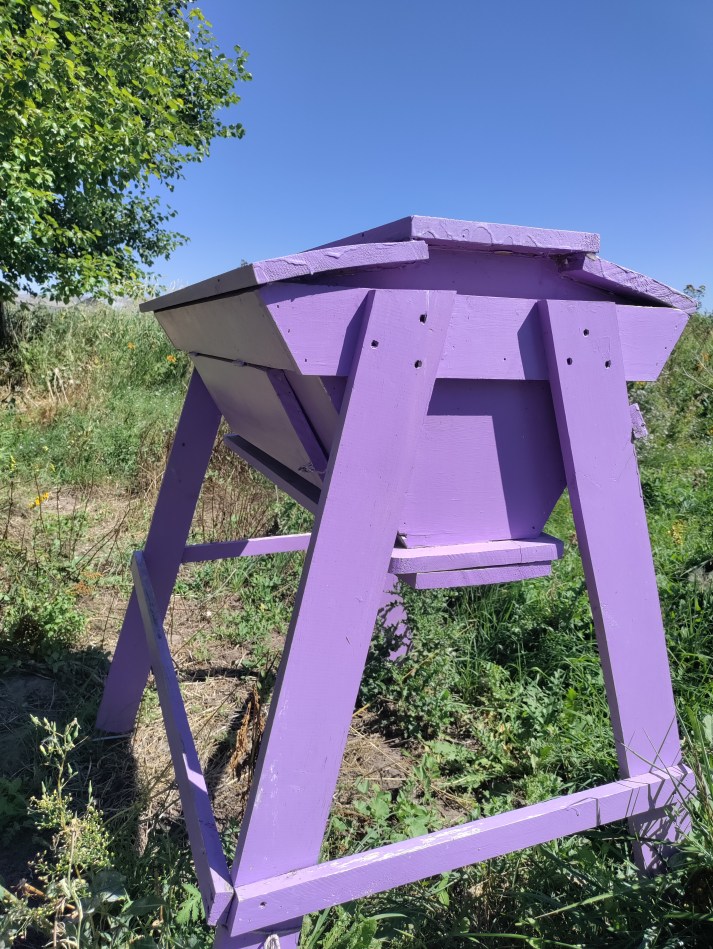
I told her someone theorized that if hives are different colors, it helps the bees find their way home. That was all the excuse some of us needed to pretty up our bee houses.
When I asked the young clerk at the Lowe’s paint desk for lavender outdoor paint, he protested. “No. Lavender isn’t an outdoor color.” Even after I explained it was for a bee house, he frowned while mixing it. It went against his grain.
Some beekeepers go beyond simple painting—they add flowers, designs, and stripes to the hives, and the bee yard becomes almost as attractive as nearby flower plots.
Painting hives in assorted pastel colors is not practical for commercial bee keepers, and big producers also have less choice in what kind of structure to house their bees. Commercial outfits use the Langstroth hive, the box-like hive people see from their car windows, sitting side-by-side in fields or on hillsides. This is the most popular hive for backyard beekeepers, too, and has proven itself over time.
Rev. Lorenzo Langstroth, a Presbyterian minister, invented the Langstroth hive in l851. In one version of the story, he wanted to build a hive that allowed people to harvest honey without driving the bees out with fire. The more common version says the reverend discovered “bee space,” the distance between combs that bees prefer, and he designed his hive accordingly.
Langstroth hives come with premade frames that hang side-by-side. Bees can go right to work filling combs with brood and honey.
Some backyard beekeepers like top bar hives. The beekeeper merely places bars at the top of the hive, and bees build the combs themselves. This takes longer, though some energetic hives can produce a triangular-shaped comb very quickly. But in northern climates, every warm day counts, and top bar hives don’t produce as much honey as Langstroths do.
Today, many honey producers supplement their incomes by sending their bees to the California almond groves to pollinate them. The Langstroth hive is portable, and its square shape means many fit on a semi-trailer. Top bar hives are stationary.
Fans of top bar hives, and the similar Warre and Kenyan hives, like that their bees put brood and honey on comb freshly made by the bees, rather than on plastic frames that may contain a variety of chemicals. No expensive extracting equipment is needed. The beekeeper simply removes a single comb at a time and puts it in a squeezer made of two triangular-shaped pieces of wood, suspended over a large bowl. Every day, the beekeeper tightens clamps, until all the honey is squeezed out. The wax can be rendered for candles and other uses.
Top bar advocates believe the top bar design promotes good air circulation, making condensation, which can be a problem, less likely. Langstroth fans point out that their hives can expand—they merely add a box atop their full one. Top bar hives run out of room.
For all our preferences and debates about the best way to raise bees, we see that bees settle nicely into cavities of trees and under edges of objects to hide from predators. It appears they have less disease in the wild.
Bees get along nicely without us. But we can’t do without them.

 1000 Reasons to Love Bees