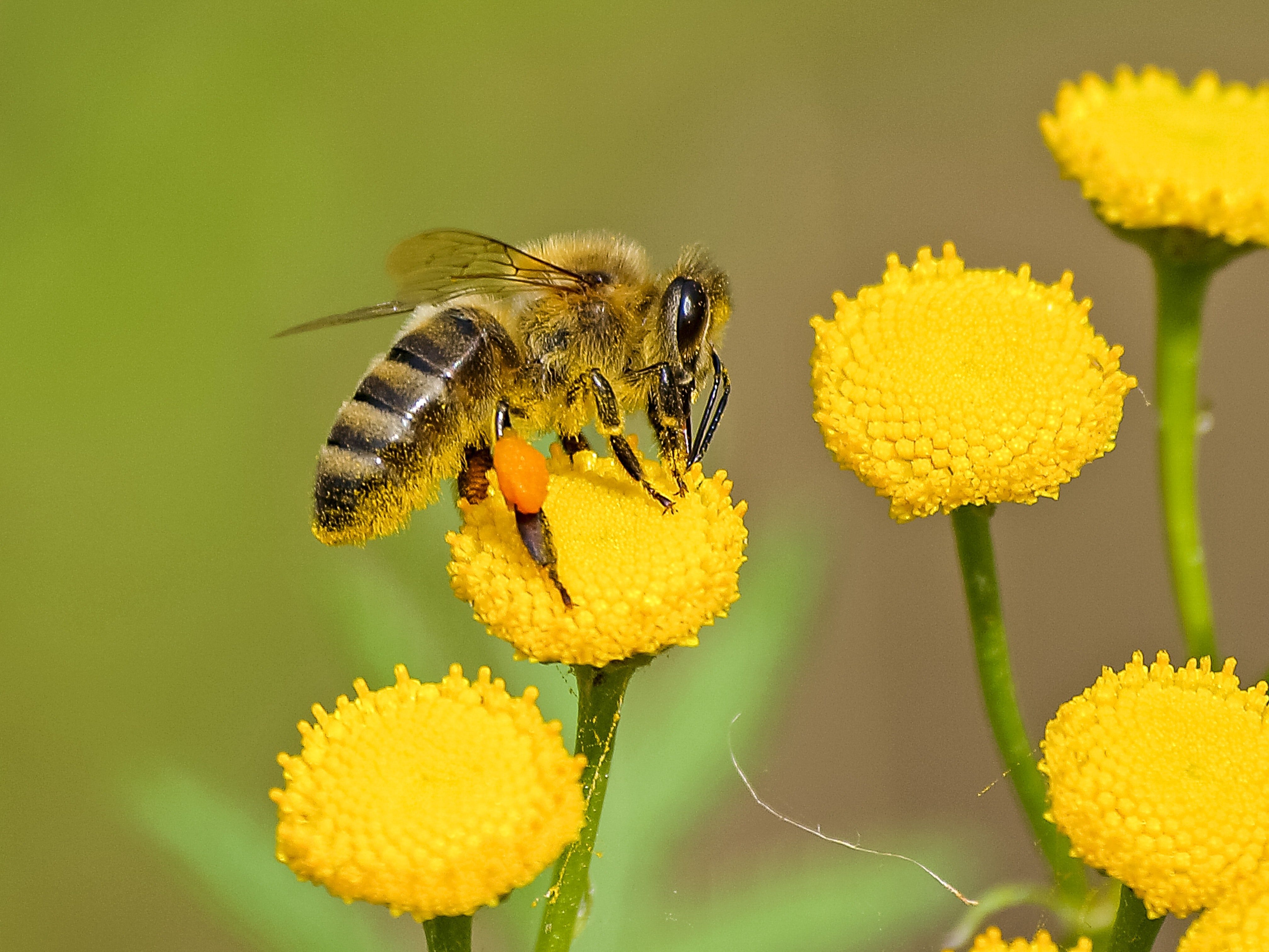

A close look at any species, including our own, teaches us that living creatures adapt well to their environment. But the honey bee could win a prize for inhabiting a body superbly suited to her life and mission.
Collecting nectar? The bee proboscis, a straw-like tongue, allows her to drink deeply from flowers. The proboscis also conveys taste. And, it allows for the transfer of food between bees, which is a part of honey production. Bees trade information, too, while transferring food.
The bee proboscis is half as long as the bee’s head, which allows it to reach far into a blossom. The hairy tongue sticks to nectar, to pull it toward the mouth. As the bee feeds, a hollow bulb works like a pump to transfer nectar to the bee’s honey stomach. When not in use, the jointed proboscis folds up in the mouth, like pleats of an accordion.
The bee has mandibles for chewing. Honey bee mandibles are spatula-shaped, with broad, flat tips for spreading and shaping wax.
Bees have sensilla—hair-like structures sensitive to particular substances, located on their mouth parts and on their antennae.
Honey bee antennae function as a sensory power house, giving the bee the ability to touch, smell, taste and even hear.
Bees talk with other bees by touching antennae. Honeybees rely mainly on the right antennae to communicate, which mystifies scientists. Studies showed that bees don’t function as well when forced to use only their left antennae.
For many years, scientists thought bees, despite having powerful primary senses, couldn’t hear. Yet, bees responded to sound, which baffled them. The bee had nothing resembling an ear. It turned out that receptors on their antennae detect vibrations and the movement of air particles.
Other places on the bee body can detect odors, but the antennae do the heavy lifting. They pack a whopping 170 odor receptors, which give bees their keen sense of smell.
A dog’s ability to smell is 10,000 times greater than that of a human, scientists say. During the pandemic, scientists conducted experiments to see if dogs could sniff out Covid. They could. But in separate experiments with bees, bees did it better. Experiments using dogs to sniff out cancer have shown much promise, but bees outperformed dogs in that, too.
One time a guest arrived at my house, eager to visit the bees. He admired bees and welcomed them to his fruit trees, but he had never stood close to a hive. Absorbed in conversation, I neglected some safety considerations. I stopped directly in front of the hive entrance, which puts guard bees on edge, and I wore a red shirt, a color bees dislike.
Bees zoomed out of the hive, and two stung my guest on his face. He outran a third one. They should have stung me. I’m guessing they suspected an invader, but flew past me because they knew my scent.
Next time: More on the buzzy body.

 1000 Reasons to Love Bees