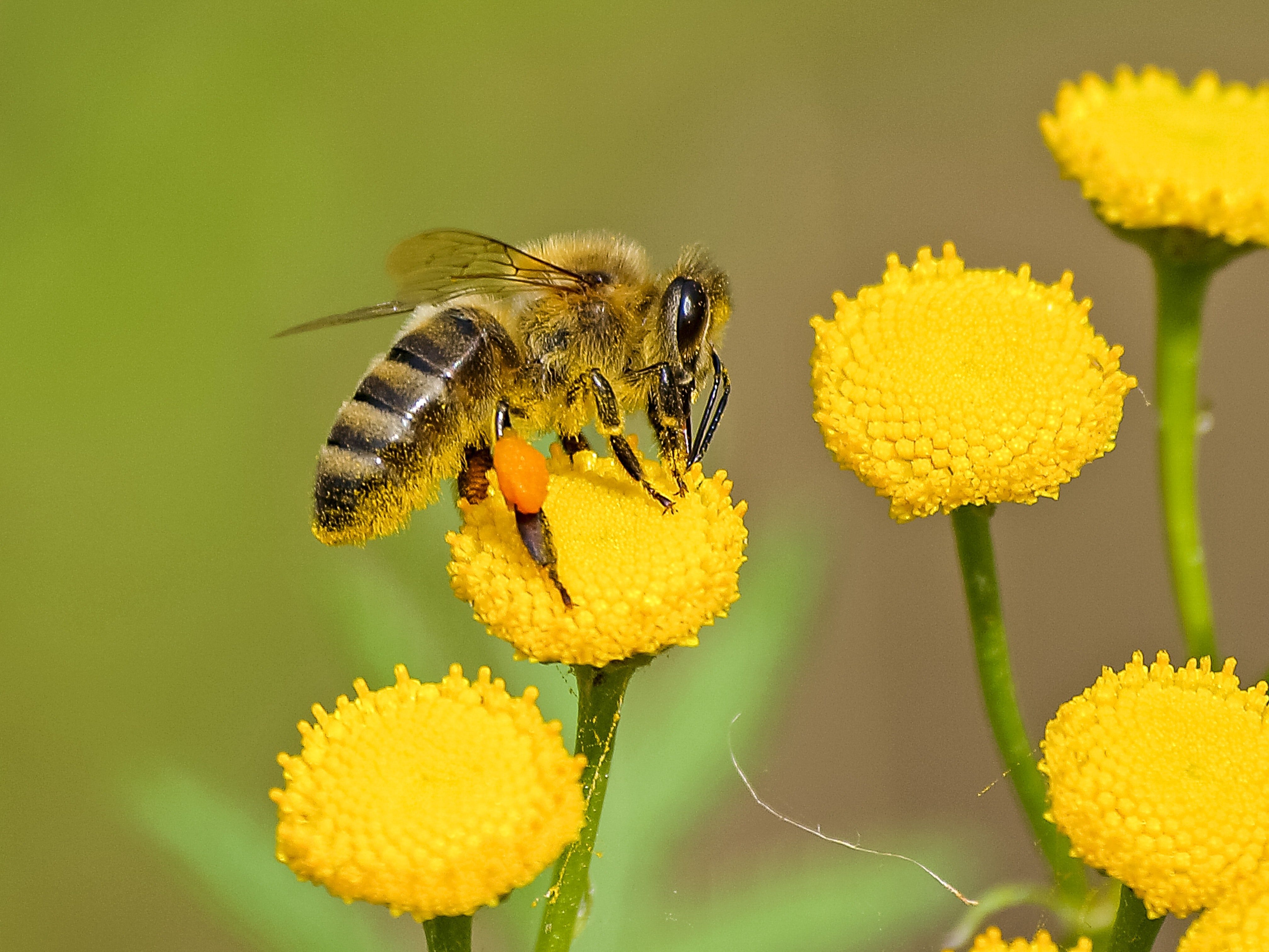
The last post, describing the bee’s marvelous body, got only as far as their crazy mouths and multi-talented antennae. On to the brain and eyes.
Scientists like to study bees because of their cognitive abilities. The honeybee brain, small as a poppy seed, manages complex tasks and social interactions that guide colony life. Like the waggle dance, which forager bees perform to tell others where the blooms are. The dancer conveys location, quantity, and quality of her discovery.
A worker bee becomes a forager after holding many other jobs in the hive, and when she does, a navigator gene switches on in her brain. Researchers have found that bees rely not only on scent and air pressure to find their way—they also memorize landmarks. Bees remember patterns and faces as well, and understand concepts such as above/below, and same/different.
One citizen-scientist experiment showed that bees learned faster when treated with caffeine than bees treated with dopamine, and the control bees. A study in the European Union showed that bees can count – at least up to five. And similar to humans, bees process information differently in the two hemispheres of their brains.
Those of us who react with fear when Math rears its complex head may feel uneasy about the results of an Australian study. That research showed that bees can learn to add and subtract.
To find flowers, bees need good vision. Bees pick up odor cues, but only if they are close. They need to see them from a distance. The bee has five eyes—two, large compound eyes made up of many tiny lenses, and three simple eyes located on the top of the head that detect light. A bee can sense a predator approaching from above.
The two larger eyes have tiny hairs that detect wind direction and allow bees to navigate when it is windy. Bees can see polarized light (light that goes through a filter), so bees can view the sun on a cloudy day.
Bees can detect motion in as little as 1/300th of a second. This allows them to see flowers swaying in the smallest breeze. Humans detect movement if it happens for longer than 1/50 of a second.
Bees can see in the ultraviolet spectrum, which humans cannot. Flowers that depend on bees for pollination have ultraviolet color patterns that catch the bee’s eye.
Bees can distinguish dark from light, which allows them to see edges, which helps them identify shapes.
Bees cannot see the color red, and interpret it as black, which they associate with predators. Bears, skunks, and raccoons have black noses. There is agreement that bees can’t see white, which is why beekeepers wear white bee suits and veils.
Next time. More on the Incredible Buzzy Body.

 1000 Reasons to Love Bees