
A friend loaned me a novel where a woman beekeeper tells much of the story. The book had great pacing, and the author showed a knowledge of beekeeping and honey collection. For a while, I wondered if the writer might be a beekeeper. But at some point, I decided she wasn’t. I read up on her, and it appears she isn’t.
Yesterday I saw an email from a beekeeper that included the statement, “Nothing humbles me like observing bees.” That was it! What I found missing in the novel. The author had a ton of information, but didn’t convey the awe that beekeepers feel for bees.
I’m generalizing. Some beekeepers may have a strictly practical outlook on beekeeping. But the ones I know rhapsodize about the small creatures in their care.
The bee body perfectly suits the role the bee plays in nature. Previously, we looked at the bee’s antenna, mouthparts, and brain. Now we’ll look at the rest of the body.
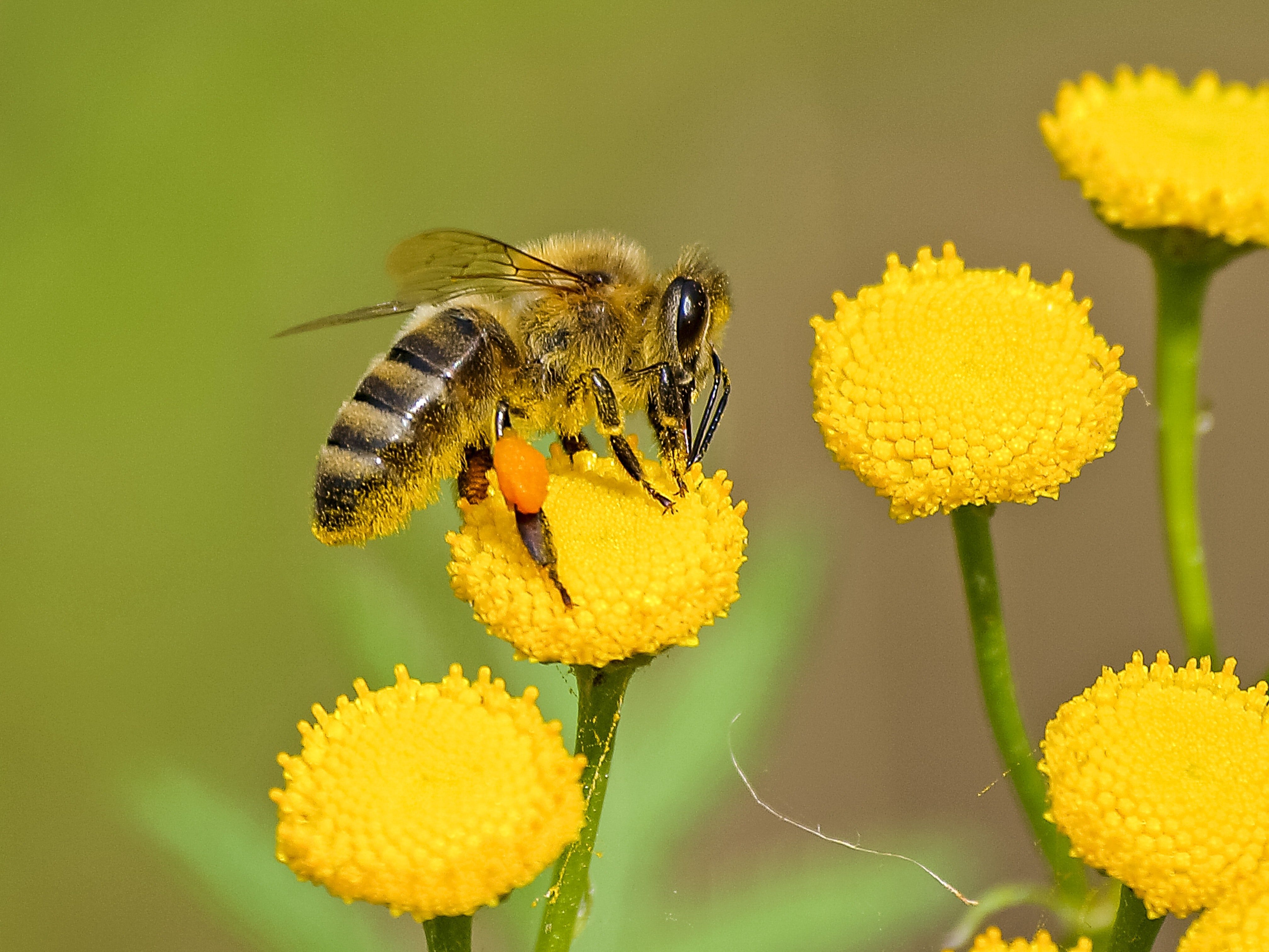
Some animals and insects try to hide from predators. That would not work for bees, considering their occupation. They advertise their presence with light and dark stripes, warning predators and intruders to be careful—they can sting. Workers have a barbed stinger. Extracting it from mammalian skin usually kills the bee. Queen bees don’t have barbed stingers and could sting repeatedly, but humans seldom encounter a queen, and being stung by one is rare. Drone bees don’t have stingers.
The honeybee has a layer of hair on its body to aid in gathering pollen and regulating body temperature.
The thorax (midsection), with its six legs and two pairs of wings, focuses on locomotion. Muscles in the thorax control the movement of the wings during flight, and rapid contractions control the movement of the wings. Lift-off happens when the bee does a propellor-like twist of its wings. A bee can fly at 15 miles per hour. Though a bee’s normal range is a three-mile radius, researchers found that bees can fly up to 25 miles in extenuating circumstances.
Honey bee’s legs have six sections, making them flexible. The legs have taste receptors on the tips. The legs have claws for gripping, and sticky pads for landing on slick surfaces.
The front legs clean antennae; the rear legs have what are called pollen baskets, concave structures where pollen accumulates. The bee on a flower brushes the pollen that sticks to her body toward her hind legs. She mixes in some nectar to help keep the pollen together during flight.
The honeybee has two stomachs, one for collecting nectar, sometimes known as the crop. A special structure at the end of the crop prevents food from the other stomach entering and contaminating the nectar. When people call honey bee barf, that misunderstands the process. The crop can swell the abdomen to twice its size when transporting nectar.
The rectum also can swell. Bees won’t poop in the hive, so in northern climates like Idaho, bees go months waiting for a warm day to take a cleansing flight.
In queen bees, the abdomen holds the spermatheca, which stores an infinite number of sperm collected during her single mating flight. She goes home to lay 1,000 to 2,000 eggs a day until she dies, or the hive deposes her.
Most drones never mate. The few who do die in the act. The drone’s ejaculation is so explosive, the human ear can hear it. After that, the drone’s internal organs are ripped from him and he falls to his death. Sometimes a person comes across a drone in his death throes, and it is pitiful to see.
Young worker bees have the job of creating wax. Wax-producing scales located on the underside of the abdomen secrete liquefied wax, which hardens into thin scales when exposed to air. A worker creates about eight scales in a 12-hour period. A thousand scales make a single gram of wax. As a new beekeeper, I admitted at a beekeeper’s club that I threw away the wax. People turned and looked at me with horror. I don’t waste it now.
The next time you see a honey bee, consider how intricate, efficient, productive, and marvelous that tiny body is. And be humbled.

 1000 Reasons to Love Bees