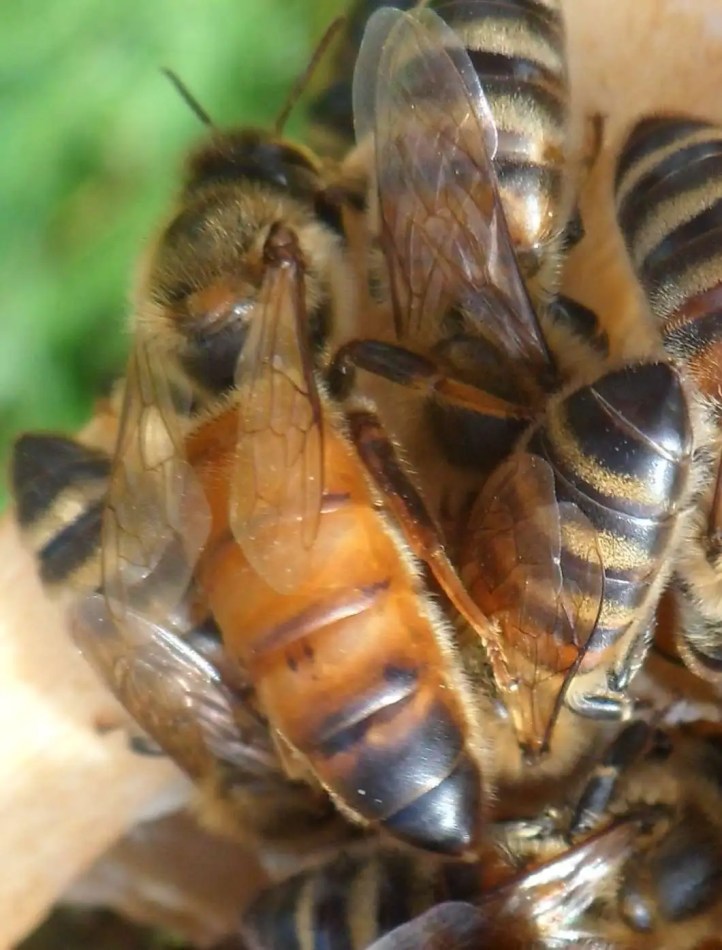
Photo by Roland Prakel-Close-up of a queen bee
Bees face many perils. The ones we humans have introduced into their lives, like deadly chemicals and loss of healthy habitat, and ones that Nature puts in their path. Bees have enemies small and large, and must be vigilant.
Two years ago, during an especially brutal winter, mice invaded my hives and made a disgusting mess, as well as destroying a colony. Beekeepers install mouse guards to prevent such disasters, but I had become complacent because my type of hive sits high above the ground. I’ve gone back to using mouse guards.
Bears broke through a regular fence and smashed my daughter-in-law’s hives. She and my son bought a heavy-duty, electrified fence that would repel bears. They gave up beekeeping a year or two later because flowers in their area disappear in midsummer. The fence guards chickens now.
Skunks and raccoons also invade hives. Wasps do too. It appears inconsistent—how much beekeepers value one variety of insect, and loath another. The enemy of my friend is my enemy. Like many others, I have lost a hive to wasps. And one time, I interrupted an invasion.
Spiders can prey on bees, so I remove the icky, sticky webs that jumping spiders make on the edges of combs, though I suppose the spiders wouldn’t cause great harm.
If a hive loses its queen and the beekeeper buys a replacement, the beekeeper introduces the new queen to the colony with tact, allowing time for adjustment. Older bees may be reluctant to accept a newcomer.
In spring, when people buy new bees, the bees arrive in one of two ways. In an established colony, where the queen and workers know each other and the queen is already at work. Or, in a nuc (nuclear colony) where the queen is in a cage, and will be released after the workers get acquainted with her. In cold climates, where summer is short, the nuc loses days in the adjustment period, whereas an established colony goes right to work. But nucs are less expensive. And people like me, who run an atypical style of hive, must choose nucs.
When the nuc arrives, workers already surround the queen cage. It appears the workers like the queen and are protecting her. But the beekeeper must look closer. Maybe the workers want to get to the queen to kill her. It’s all about scent, we’re told.
After a few-day period of observation, the beekeeper releases the queen. Fumbles may occur during this action. One time I dropped the queen in the grass. A friend who was helping spotted her, carefully picked her up, and deposited her in the hive.
Bees resemble us in the way they accept a newcomer. When a new neighbor arrives, we grumble. Their new house blocks our favorite view. We liked the old neighbor and wish they hadn’t moved. The new neighbor owns a peacock, whose raucous call awakens us in the mornings.
Then one day, the new neighbor shows up at our door with a warm loaf of good-smelling bread. In chatting together, we discover we attended the same college. Our kids ran track together. The new neighbor has an adorable dog. We see the potential for friendship.
Like a queen bee, the new neighbor gets incorporated into the colony/neighborhood.

 1000 Reasons to Love Bees