bees, pollinators, beekeeping, environment · natural cures · nature

The Incredible Buzzy Body-Part Three

A friend loaned me a novel where a woman beekeeper tells much of the story. The book had great pacing, and the author showed a knowledge of beekeeping and honey collection. For a while, I wondered if the writer might be a beekeeper. But at some point, I decided she wasn’t. I read up on her, and it appears she isn’t. 

Yesterday I saw an email from a beekeeper that included the statement, “Nothing humbles me like observing bees.” That was it! What I found missing in the novel. The author had a ton of information, but didn’t convey the awe that beekeepers feel for bees. 

I’m generalizing. Some beekeepers may have a strictly practical outlook on beekeeping. But the ones I know rhapsodize about the small creatures in their care.  

The bee body perfectly suits the role the bee plays in nature. Previously, we looked at the bee’s antenna, mouthparts, and brain. Now we’ll look at the rest of the body.

Some animals and insects try to hide from predators. That would not work for bees, considering their occupation. They advertise their presence with light and dark stripes, warning predators and intruders to be careful—they can sting. Workers have a barbed stinger. Extracting it from mammalian skin usually kills the bee. Queen bees don’t have barbed stingers and could sting repeatedly, but humans seldom encounter a queen, and being stung by one is rare. Drone bees don’t have stingers.

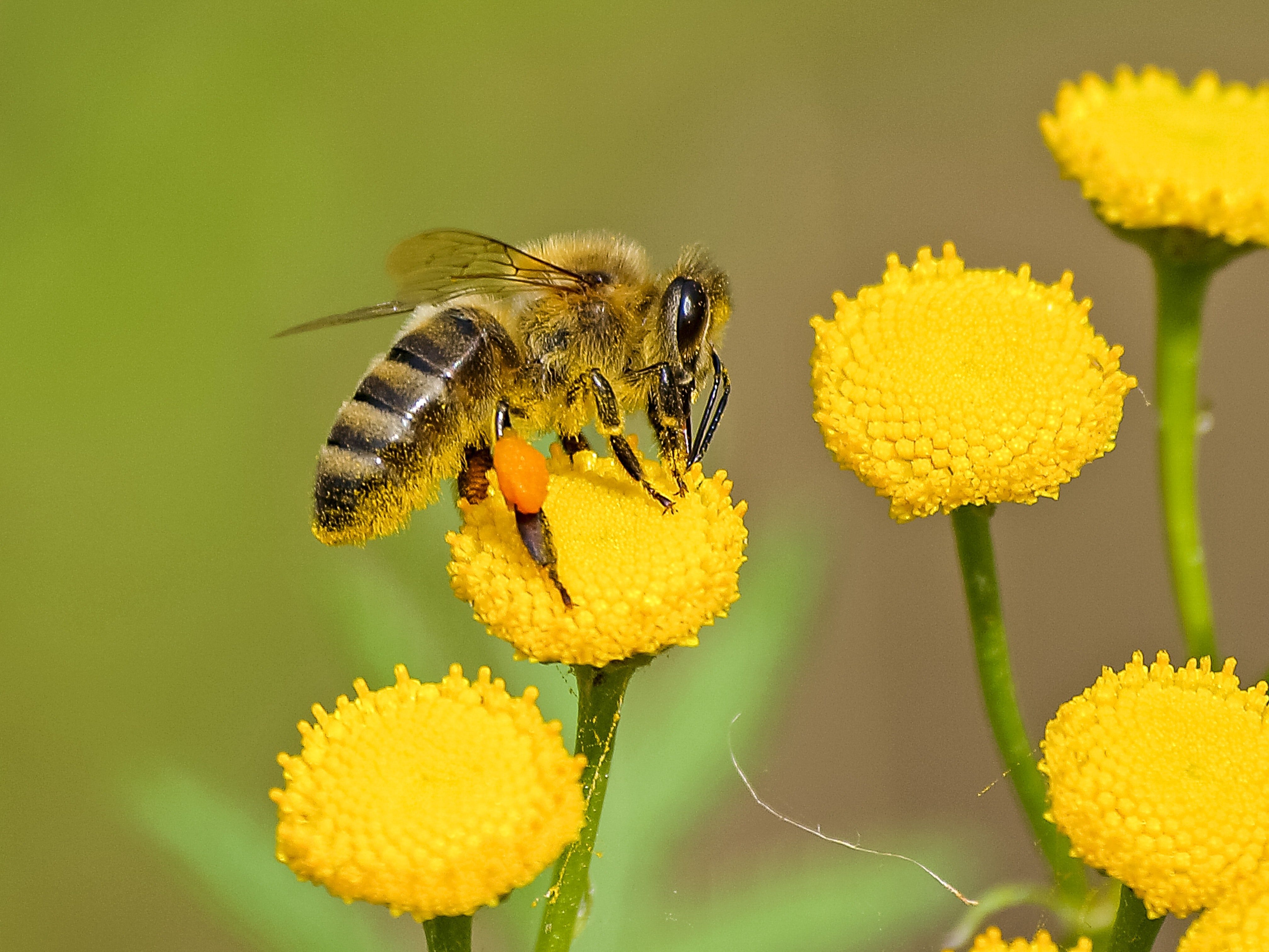
 The honeybee has a layer of hair on its body to aid in gathering pollen and regulating body temperature.

The thorax (midsection), with its six legs and two pairs of wings, focuses on locomotion. Muscles in the thorax control the movement of the wings during flight, and rapid contractions control the movement of the wings. Lift-off happens when the bee does a propellor-like twist of its wings. A bee can fly at 15 miles per hour. Though a bee’s normal range is a three-mile radius, researchers found that bees can fly up to 25 miles in extenuating circumstances. 

Honey bee’s legs have six sections, making them flexible. The legs have taste receptors on the tips. The legs have claws for gripping, and sticky pads for landing on slick surfaces.

The front legs clean antennae; the rear legs have what are called pollen baskets, concave structures where pollen accumulates. The bee on a flower brushes the pollen that sticks to her body toward her hind legs. She mixes in some nectar to help keep the pollen together during flight.

The honeybee has two stomachs, one for collecting nectar, sometimes known as the crop. A special structure at the end of the crop prevents food from the other stomach entering and contaminating the nectar. When people call honey bee barf, that misunderstands the process. The crop can swell the abdomen to twice its size when transporting nectar.

The rectum also can swell. Bees won’t poop in the hive, so in northern climates like Idaho, bees  go months waiting for a warm day to take a cleansing flight. 

In queen bees, the abdomen holds the spermatheca, which stores an infinite number of sperm collected during her single mating flight. She goes home to lay 1,000 to 2,000 eggs a day until she dies, or the hive deposes her.

Most drones never mate. The few who do die in the act. The drone’s ejaculation is so explosive, the human ear can hear it. After that, the drone’s internal organs are ripped from him and he falls to his death. Sometimes a person comes across a drone in his death throes, and it is pitiful to see.

Young worker bees have the job of creating wax. Wax-producing scales located on the underside of the abdomen secrete liquefied wax, which hardens into thin scales when exposed to air. A worker creates about eight scales in a 12-hour period. A thousand scales make a single gram of wax. As a new beekeeper, I admitted at a beekeeper’s club that I threw away the wax. People turned and looked at me with horror. I don’t waste it now.

The next time you see a honey bee, consider how intricate, efficient, productive, and marvelous that tiny body is. And be humbled.
bees, pollinators, beekeeping, environment · natural cures · nature

The Incredible Buzzy Body, Part 11

The last post, describing the bee’s marvelous body, got only as far as their crazy mouths and multi-talented antennae. On to the brain and eyes.

Scientists like to study bees because of their cognitive abilities. The honeybee brain, small as a poppy seed, manages complex tasks and social interactions that guide colony life. Like the waggle dance, which forager bees perform to tell others where the blooms are. The dancer conveys location, quantity, and quality of her discovery.

A worker bee becomes a forager after holding many other jobs in the hive, and when she does, a navigator gene switches on in her brain. Researchers have found that bees rely not only on scent and air pressure to find their way—they also memorize landmarks. Bees remember patterns and faces as well, and understand concepts such as above/below, and same/different.

One citizen-scientist experiment showed that bees learned faster when treated with caffeine than bees treated with dopamine, and the control bees. A study in the European Union showed that bees can count – at least up to five. And similar to humans, bees process information differently in the two hemispheres of their brains.

Those of us who react with fear when Math rears its complex head may feel uneasy about the results of an Australian study. That research showed that bees can learn to add and subtract.  

To find flowers, bees need good vision. Bees pick up odor cues, but only if they are close. They need to see them from a distance.  The bee has five eyes—two, large compound eyes made up of many tiny lenses, and three simple eyes located on the top of the head that detect light. A bee can sense a predator approaching from above.

The two larger eyes have tiny hairs that detect wind direction and allow bees to navigate when it is windy. Bees can see polarized light (light that goes through a filter), so bees can view the sun on a cloudy day.  

Bees can detect motion in as little as 1/300th of a second. This allows them to see flowers swaying in the smallest breeze. Humans detect movement if it happens for longer than 1/50 of a second.

Bees can see in the ultraviolet spectrum, which humans cannot. Flowers that depend on bees for pollination have ultraviolet color patterns that catch the bee’s eye.  

Bees can distinguish dark from light, which allows them to see edges, which helps them identify shapes.  

Bees cannot see the color red, and interpret it as black, which they associate with predators. Bears, skunks, and raccoons have black noses. There is agreement that bees can’t see white, which is why beekeepers wear white bee suits and veils.    

Next time. More on the Incredible Buzzy Body.

bees, pollinators, beekeeping, environment · natural cures · nature

The Marvelous Buzzy Body

bees, pollinators, beekeeping, environment · natural cures · nature

Is Cooking with Honey Healthier?

A joke in beekeeping circles is, “Ask four beekeepers a question, and you will get five answers.”

I find beekeepers a congenial lot, but it’s true they hold conflicting opinions on many subjects. Like, how best to house bees, mite control—natural or chemical? —and frequent hive inspections vs. leave-bees-the-heck-alone. It is not surprising that the bee community, which includes bee researchers, disagrees about whether using honey in cooking and baking has health benefits.  

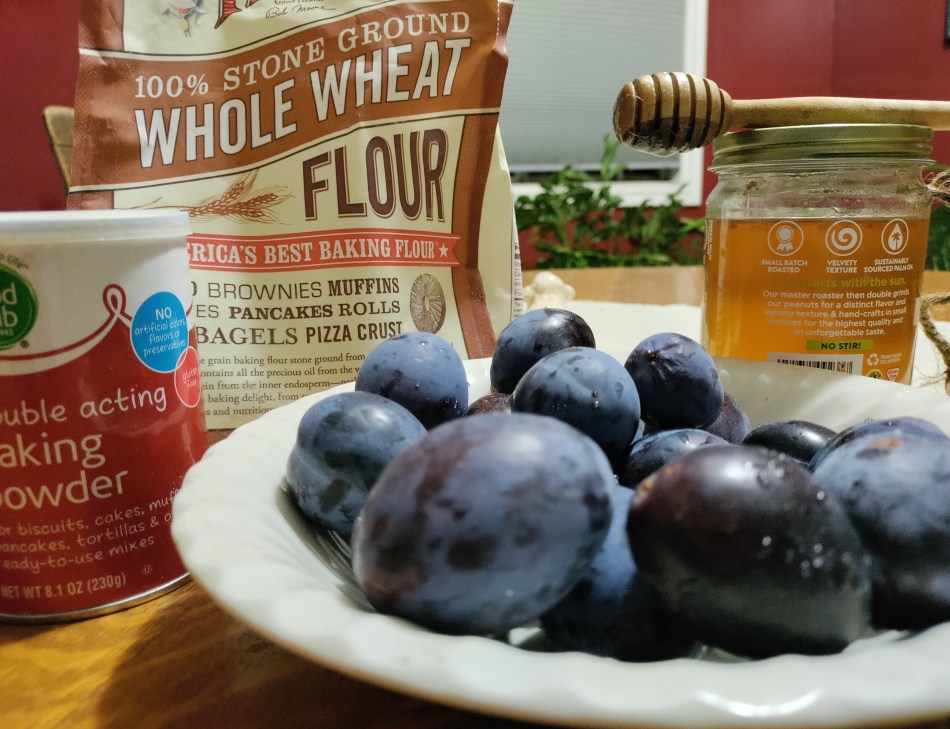
I don’t think anyone disputes that dishes and baked goods made with honey taste better. Custards made with sugar taste fine; custards made with honey taste glorious. Same for granola, and vegetable and meat glazes made with honey.

Many frontier recipes call for honey. Our great-grandmothers cooked with it because rural people kept bees.

When sugar was cheap, natural food advocates wanted to give people a reason to use expensive honey in cooking. Honey had antibacterial properties and antioxidants, vitamins, and minerals. Beekeeping sites and honey producers run food recipes that call for honey, along with recipes for honey-based beauty products like facial scrubs, and health remedies like wound ointments. But many people believe that the good properties in honey don’t survive heating.    

Practitioners of Ayurvedic medicine, an ancient health system still honored in India, claim that heating and cooking honey changes its natural composition. This, they believe, allows for toxic molecules to stick to mucous membranes of the digestive system, which can convert to a toxin called Ama, which leads to upset stomach, affects respiration, insulin sensitivity, skin diseases, and weight gain. For those who do not buy that, Ayurvedic proponents still advise—don’t heat honey, because it wastes honey’s health benefits. Don’t even put it in hot liquids. What? Morning tea without honey?

But what about the university research that validated the old-time remedy of honey in hot liquids? They found it beneficial for coughs and sore throats.  

It gets confusing. An article circulated by extension services laid down guidelines for heat and honey. Honey should not be heated rapidly over direct heat. The hotter the heat, the more potential for reducing nutritional value.

Honey begins to lose its healthful properties at 113F, and worsens at 122 F. It doesn’t say how long it takes for that damage to occur. One site recommends letting tea or coffee cool to a drinkable temperature before adding the honey.

As with most arguments, we can find evidence to support the theory we like best. Some articles say heat destroys the beneficial elements in honey, some say honey has a multitude of healthful components, some of which survive cooking. Some people point out that honey, even cooked, has a lower glycemic index and is better for people with diabetes and hypoglycemia. Some concede that honey loses some of its bioenzymes with cooking, but still imparts a nice aroma and flavor to baked goods.    

We may wish to consider the Placebo Effect and the Happiness Factor, too. When we believe a substance or pill helps our body, it does, even if the pill is worthless. Machines and tests have measured that in labs. And when we enjoy something, it triggers all sorts of health benefits, also verifiable in the lab. A recent study proclaimed ½ cup of ice cream per day as a surefire way to bolster health.

Take that, naysayers!  

bees, pollinators, beekeeping, environment · natural cures · nature

Up on the Roof, with Bees

Movies and TV shows sometimes set romantic scenes on rooftops.

Elegant food appears on a table laid with a linen cloth and fancy crystal. Lovely music plays on a speaker. After dining, the lovers nestle at the roof’s edge and gaze down on blinking lights.  

A rural person like me may think, “What is romantic about noise, crowding, and light pollution that obliterates the stars?” But it is all about what you’re accustomed to. These days, bees who formerly lived in meadows, trees, and yards are getting used to living on rooftops.  

Beekeepers in urban places have started to locate hives on top of buildings. Some studies report urban bees can be stronger and healthier than suburban and rural bees. It relates to diet. A variety of blooms makes bees healthier, and sometimes cities and towns offer a greater variety of flowers. In the suburbs and rural places, bees may harvest only one or a few kinds of blooms.  

In many places, towns and cities that had rules against beekeeping have changed their minds.  The local food movement helped jettison laws and codes that prohibited bees. Urban gardeners applaud the change; urban shopkeepers like to stock local honey.

Urban children who have bees living atop their building are brought closer to nature. They have the opportunity to observe bees coming and going, and they also learn to be careful around them.  

In response to the decline of bee numbers, the General Services Administration adopted the Pollinator Initiative that encourages federal facilities to locate bee hives on their roofs. Bee raisers contract with the government to locate hives atop courthouses and other federal buildings. One such facility is the Warren B. Rudman courthouse in Concord, New Hampshire.

The hives serve a research role, too. Program directors collect data on subjects like what plants are most beneficial to bees, and whether bees on rooftops benefit the flora of the entire area. The program hopes that if bees thrive, lessons learned can be passed along to other facilities, private and governmental.   

 A roof top must offer the bees a close source of water, so bees don’t have to expend a lot of energy travelling. And the roof should offer optimum temperatures in summer and winter.

But when too many hives live in an area with limited green spaces and flowers, bee health will suffer. This has been observed in London and New York City.

Urban settings can also be incubators for disease. Urban beekeepers must treat their hives for disease more often than rural beekeepers do, which is costly. And honeybees may pick up contaminants from city environments, which will appear in the honey. Beekeepers have found that sometimes honey produced by their bees was made from artificial sugars gathered from the urban environment.

Despite those hazards, rooftop beekeeping may help reverse the decline of bees. One bonus of the federal program has already come to pass. When bees produce more honey than they need, the excess goes to local food banks.

bees, pollinators, beekeeping, environment · natural cures · nature

Bees Need Their Zzzz’s

 Like most humans, bees labor in the daytime and slumber at night. Like us, they sleep for five to eight hours, and don’t function well if they miss those hours. Like us, they go through different stages of sleep—lighter to deeper. When they awaken, they take a while to get moving—no coffee available. They may stay immobile for a while, or quietly groom themselves or others.

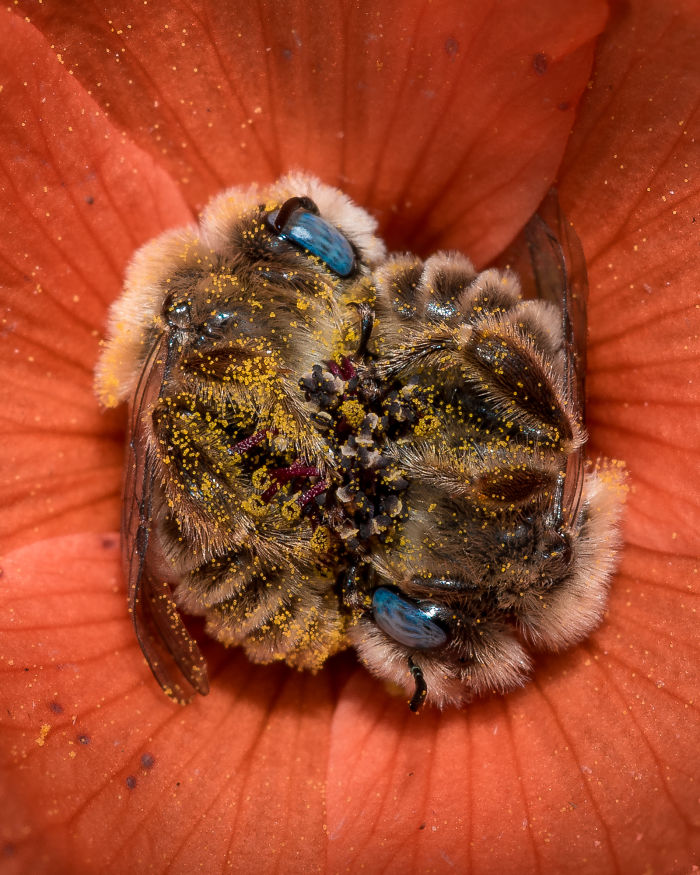
Bees who don’t live in colonies, particularly males, often sleep on flowers. They grab hold of the flower with either their legs or mandibles. If the flower closes, that is all to the good, offering the bee protection from predators. Female solitary bees are likely to make nests. In the daytime, they visit flowers in search of nectar and pollen. The male bees take only quick sips of nectar, and devote their time to searching for a female to mate with, or driving off other males.

Honey bees sleep in their hives or nests. The foragers, who are older bees, generally sleep outside of cells, near the edge of the nest where it is cooler, and away from uncapped brood. Young worker bees usually sleep inside cells, near the center of the nest. They may not sleep consecutive hours, but waken and work at their jobs, sleep for a while, and then return to work.   

When bees lose sleep, they become less competent at their jobs. Researchers showed that sleep-deprived bees could not properly perform the waggle dance that tells their sisters where the blooms are. Foragers had trouble navigating a new route home, and showed signs of sleepiness, like, they moved their antennae less.

What disrupts bees and their sleep? Bears, raccoons, skunks, and mice raid at night and alarm the hive. Light and noise from humans can put a colony on edge.  

But troubling studies have shown that neonics, chemicals used in pesticides, upset the sleep cycle of bees and flies. One study of bumble bees found that when bees received a dose of neonics, in the amount they would encounter in normal life, it disturbed their usual sleep pattern. The bees slept more in the daytime, and tried to forage at night when flowers were unavailable.

If you come across a bee flitting about, not overly interested in flowers, it may be a solitary male searching for a female, or others males to chase off. Or it could be a normally ambitious forager, wandering about because she is short on sleep.

The World Wildlife Federation tells us that 90 percent of wild plants and 75 percent of the leading global crops depend on pollination. The pollinators have an enormous job. They need their rest.

bees, pollinators, beekeeping, environment · natural cures · nature

Housing the Honey Makers

“Why are your hives painted different colors?” my neighbor asked.

I told her someone theorized that if hives are different colors, it helps the bees find their way home. That was all the excuse some of us needed to pretty up our bee houses.

When I asked the young clerk at the Lowe’s paint desk for lavender outdoor paint, he protested. “No. Lavender isn’t an outdoor color.” Even after I explained it was for a bee house, he frowned while mixing it. It went against his grain.

Some beekeepers go beyond simple painting—they add flowers, designs, and stripes to the hives, and the bee yard becomes almost as attractive as nearby flower plots.  

Painting hives in assorted pastel colors is not practical for commercial bee keepers, and big producers also have less choice in what kind of structure to house their bees. Commercial outfits use the Langstroth hive, the box-like hive people see from their car windows, sitting side-by-side in fields or on hillsides. This is the most popular hive for backyard beekeepers, too, and has proven itself over time.

Rev. Lorenzo Langstroth, a Presbyterian minister, invented the Langstroth hive in l851. In one version of the story, he wanted to build a hive that allowed people to harvest honey without driving the bees out with fire. The more common version says the reverend discovered “bee space,” the distance between combs that bees prefer, and he designed his hive accordingly.  

Langstroth hives come with premade frames that hang side-by-side. Bees can go right to work filling combs with brood and honey.

Some backyard beekeepers like top bar hives. The beekeeper merely places bars at the top of the hive, and bees build the combs themselves. This takes longer, though some energetic hives can produce a triangular-shaped comb very quickly. But in northern climates, every warm day counts, and top bar hives don’t produce as much honey as Langstroths do.

Today, many honey producers supplement their incomes by sending their bees to the California almond groves to pollinate them. The Langstroth hive is portable, and its square shape means many fit on a semi-trailer. Top bar hives are stationary.     

Fans of top bar hives, and the similar Warre and Kenyan hives, like that their bees put brood and honey on comb freshly made by the bees, rather than on plastic frames that may contain a variety of chemicals. No expensive extracting equipment is needed. The beekeeper simply removes a single comb at a time and puts it in a squeezer made of two triangular-shaped pieces of wood, suspended over a large bowl. Every day, the beekeeper tightens clamps, until all the honey is squeezed out. The wax can be rendered for candles and other uses.

Top bar advocates believe the top bar design promotes good air circulation, making condensation, which can be a problem, less likely. Langstroth fans point out that their hives can expand—they merely add a box atop their full one. Top bar hives run out of room.

For all our preferences and debates about the best way to raise bees, we see that bees settle nicely into cavities of trees and under edges of objects to hide from predators. It appears they have less disease in the wild.

Bees get along nicely without us. But we can’t do without them.  

bees, pollinators, beekeeping, environment · natural cures · nature

Who is Humankind’s Best Friend?

Most folks designate The Dog as humankind’s best friend. Stories abound that tell of dog loyalty, usefulness, bravery, and intelligence. Dogs pull sleds in the North, guide the blind, guard perimeters, detect seizures in humans before they happen, help children learn to read, and lick the hands of hospice patients. The least clever dog, who hasn’t a smidgen of agility, can change the course of a child’s life just by loving her.

Cats rank second in popularity in the U.S., but they give dogs a run for their money by starring in legions of YouTube videos. Cats rid barns and basements of rodents, purr against our necks, and remind us to put away our clean laundry.

Horses have their partisans. The Percheron crowd brag that their breed built young America. Horses have fulfilled all kinds of roles dating back to ancient times. Artists, photographers, and videographers never tire of trying to capture their beauty.

Oxen, sheep, cattle, hogs, poultry, and fish supply us with food. Yaks, water buffalo, camels, and elephants play vital roles in various cultures. Reptiles and amphibians also impact human communities. Birds enchant us when they sing, and inspire us when they soar.

Because she is small, and a bug, the bee does not come to mind when we think about close, nonhuman allies. But we cannot do without her.  Bees pollinate our key food crops, from delicious fruits to healthful vegetables and nuts. Even dairy producers depend on bees, because cows eat nourishing alfalfa.  

Bees share honey with us. While tasting great, honey also has antimicrobial and antioxidant properties. Studies continually find more ways that honey helps combat illnesses and ailments.

We enjoy the variety, beauty, and fragrance of flowers and trees that bees pollinate.   

 I am not suggesting we knock dogs off their pedestals as humankind’s Best Friend. But when we list True Friends, bees ought to be in the Top Five.  

Most of us want to do right by our friends. And bees are dying in droves.

Two things nearly anyone can do for bees: 

1. Find online the NRDC petition that asks the EPA to ban neonics, a family of harmful chemicals that wreak havoc on bees. Some of these chemicals are 5 to 10 thousand times more toxic to bees that DDT was, and they pose a threat to us, also. The EU and other countries have banned them. Or, find a petition against Bayer, their producer, or send Bayer a letter.  

2. Nourish bees. Even if you have just a window box, plant flowers that bees love.  

bees, pollinators, beekeeping, environment · natural cures · nature

Kids Helping Bees

The future that belongs to young people will need a healthy bee population for pollinating crops.  Some youth understand that. Here are three of them.

California teen Rory Hu won a science competition for her research with honeybees. The girl became concerned about bee health after reading of the serious decline in their numbers. 

Hu learned that pesticides can harm memory in bees, making them unable to find flowers, or find their way home after harvesting nectar. Hu burrowed bees from a beekeeper to run an experiment. She feared the bees at first, but later decided they are “really cute.”

Hu wanted to find out if polyphenols, a plant compound found in tea, and caffeine, a stimulant, could help bees learn. If so, they might be used to help bees regain their foraging abilities. She won $10,000 when she demonstrated they could.

A high school girl in Connecticut put forth a solution to the varroa mite problem that plagues bee colonies. Raina Jain was in high school a few years ago when she became aware of the bee crisis and started visiting beekeepers.

Varroa mites attach themselves to honeybees, feed on them, and weaken them. Bees, also contending with the adverse effects of pesticides and monoculture (planting large areas of one crop, while bees need a variety of nourishing blooms) don’t have the vigor to fight off varroa infestations.

Jain said, “I’ve been brought up with the principle of ‘live, and let live,’ to value every life, no matter how small,” Jain said. “You hear all these things on the news, but you don’t realize how important bees are until you see them firsthand. I kept hearing that bees are in danger, and the population is decreasing, but I didn’t really understand what that meant until I saw a bee farm and saw hundreds of empty and absconded hives and piles of dead bees.”

Jain wanted to design a narrow entryway that would stop the mites. She applied thymol, a naturally occurring pesticide, to the entryway. A forager bee makes 40 trips to the hive in a day, and at each departure and return, the bee had contact with thymol, which is destructive to mites, but did no harm to the bees. The small amount of pesticide did not contaminate the wax, honey, or pollen, either.

In one lab experiment, the treated-entry method caused a 70 percent reduction in mites in three weeks, with no harm to bees.

Covid interrupted further research for a while, but Jain, now a college student, has patented her entryway.

Recently, CBS Sunday morning ran the story of Maine 11-year-old Elizabeth Downs, who started keeping bees at age six and who now acts as an ambassador for them. Her local bee club, made up of adult members, named her the youth outreach person. She gives presentations at school, explaining to her peers how important bees are for the well-being of people.  

A neighbor with a large garden started Elizabeth’s education. Another neighbor, a beekeeper, saw her intense interest in bees and gave her a hive of her own and outfitted her in a way-too-big bee suit.            

 Elizabeth wanted to learn all she could, and at age 8 she enrolled in a university, online beekeeping course. 

When she is working with bees, Elizabeth feels calm.  “I love the sound of their buzz.” She aspires to one day be the state apiarist.  

bees, pollinators, beekeeping, environment · nature

Teach the Children Well

A friend posted a troubling story on Facebook about a beekeeper who came across children killing a swarm of bees by spraying them with a garden hose.

The beekeeper put a stop to it and rescued bees that might still be alive, and laid them on a dry surface to try to save them. With little luck. Usually, a wet bee is a dead bee.

We know kids can be cruel. But I would like to think something else was going on. The kids may have seen the bees as enemies. They may have thought they performed a service, saving themselves and others from stings.

It’s not like erroneous reports don’t circulate about someone who was “chased by a swarm of bees.” TV and movies show bee swarms arriving from a dark sky, accompanied by ominous music.

But swarming bees are temporarily homeless, and have little to protect. The hazard of getting stung is small. The internet posts abundant videos of beekeepers coaxing bee swarms into cardboard boxes or other containers to move them to hives. Some beekeepers do this with little or no protective clothing. Nonprofessionals should not try it. If a person gets close to the queen, guard bees may see this as a threat, and sting. 

Erica Thompson, called the Queen Bee of Tic Toc, appears in many videos scooping up handfuls of bees with bare hands. They cover her skin. She likes working without a bulky suit and gloves, she says, and thinks it is safer for the bees. She handles honeybees, and regards them as a gentle species. Thompson, who trusts the bees fully, probably communicates a scent of confidence, not fear, and bees are all about pheromones.    

Bees swarm to start a new colony. Nature built this into them for reproducing. When the hive begins to feel crowded, or inconvenienced, or short on resources, scout bees go looking for a new locale. They want to find a place with good shelter, adequate water, and abundant blooms.

If you encounter bees nosing around a tree cavity, they may be scouts. Scouts visit several places, and then decide together which is best. People who observe hive life closely tell us that bees democratically choose where and when to go.

Beekeepers watch for signs that a hive is about to swarm, and take measures to prevent it. They used to clip the queen’s wings, but that practice has mostly gone away. Beekeepers now try to separate a single hive into two, to keep the bees on the beekeeper’s property.

You may wonder, if bees are particular about finding a new home, why do swarms sometimes settle on the undercarriage of cars, in the eaves of an urban gas station, or on a well-used sidewalk? I haven’t read a satisfactory explanation. Sometimes bees check out a location for a short time before moving on. Or, do they, like us, sometimes make bad choices?   

When we consider the preparation and organization that goes into the decision to leave the hive, we need to mourn for the swarm that children drowned with a garden hose.

Whitney Huston left us good words. She pointed out that children are our future, and urged us to “teach them well, and let them lead the way.”

Next time: Youth Who Are Leading the Way.