bees, pollinators, beekeeping, environment · nature

Medicine That Tastes Good

It was easy for ancient peoples to think that the golden, delicious food given to them by the gods had the power to heal. Cultures from widely different locales believed that honey could cure a variety of ills.

In frontier America, medicines came from available sources. Like plants. And honey.

When the Scientific Age came along, researchers identified the chemical makeup of honey. They undertook studies to test whether honey had an impact on assorted maladies. Instead of disproving the folk claims for honey, science verified that honey can help restore us to health.

When my children were little, our family doctor told me that cough syrups worked okay, but they were not as effective as tea and honey. (Some folks prefer a whiskey/honey mixture.) Probably the most common medicinal use for honey is to quiet coughs. But doctors also advise patients who suffer from allergies to consume a spoonful of local honey every day. I know several people who say this has helped them when other medicines didn’t.   

Honey can have a positive impact on other health issues. It acts as an anti-inflammatory, antioxidant, and antibacterial agent. Research has shown the following:

Honey may help prevent cardiovascular disease. Antioxidants in honey may help reduce the risk of heart disease.

It can help relieve gastrointestinal complaints such as diarrhea associated with gastroenteritis. Honey might also be effective as part of oral rehydration therapy.

It may help with neurological disease. Studies suggest that honey might offer antidepressant, anticonvulsant, and anti-anxiety benefits. In some studies, honey has been shown to help prevent memory disorder.

It is useful in wound care. Topical use of medical-grade honey has promoted healing of wounds, particularly in burns.

Medical experts advise parents not to give honey to infants under one year of age. Babies face a slight risk of contracting a serious intestinal virus. After that, honey can appear on the menu in all kinds of pleasant ways.  

I eat at least a teaspoon of honey every day, and I have dodged colds for years. I’m aware that as we get older we contract fewer colds , and I’m not often around small children who carry and spread germs. Yet, even during a winter when I visited many schools, I sailed through without catching a cold.

On a recent river trip in Southern Utah, I forgot to take the small packets of dehydrated honey a friend had given to me for travel. I came home coughing and blowing my nose, with a sore throat. Something blooming in the desert may have triggered an allergic reaction, though I’m generally not allergic. Or it may have been a cold. 

When I got home, I hit the tea and honey, which soothed my throat right away. The next day, I felt much better. It could be I had left a possible allergen behind. Others folks might vote for the placebo effect—I have faith in honey, so it cures me. The scientific community would point out that the experience of a single person hardly confirms a theory.   

But we don’t have to swallow someone’s claims. Not anymore. Studies about honey and its benefits abound. You can pull up dozens with the touch of a finger. Those studies support what my wise little auntie and your sweet old granny told us. Eat honey. It helps us stay healthy.              

Next time:  More Benefits of Honey.

bees, pollinators, beekeeping, environment · nature

Whisper Words of Wisdom

Years ago at a beekeepers meeting, a tall, older woman told me the best part of having bees is watching them. Every morning she takes a pot of tea outside, sits down beside her hive, and observes bees coming and going.    

Last fall when my son and his family visited, my nine-year-old granddaughter Kora sat cross-legged in the grass in front of a hive. She called to me, “I saw a bee with pollen on its butt. Look, here’s another.” I stopped my wheelbarrow and watched for a minute. Actually, I only paused a half-minute before I moved on with my wheelbarrow. 

One year a Lutheran group came to my house to see the bees. Pastor Gina’s daughter, Naomi, who was 3, sat down before a hive and stared up at bees as they left and returned. Her mama sat down with her.

“Back up a bit,” I said. I didn’t want guard bees mistaking the guests’ intention, but that was overly cautious. The bees took no notice of them.

Every year I promise myself I will take a cup of tea, sit by a hive, and watch bees. This morning, I did. I didn’t take a timepiece, because I would have been tempted to consult it. Just tea and a notebook.

The morning rush, when bees leave to go to work, had passed. The round exit/entrances get crowded in early morning and evening. Hive builders make them small so guard bees have less area to patrol. By the time I sat down, bees who had collected nectar had started to arrive back, a dozen or so at a time.

Some flew directly into one of the two holes. Some arrived and walked up and down the hive wall for a few seconds. Checking to make sure this was their own hive? 

The plumber is coming. How much will it cost, I wonder.

The small group of bees makes only a faint buzz. Unlike in the tall lilac bushes and ornamental plum tree, which this week vibrate at high volume from foragers at work.  

 The people who lace weed and other drugs with deadly Fentanyl—how do they sleep?

The bees use one hole more than the other. Because it’s further from the edge, and seems safer? Or, do they see one hole as an exit and one as an entrance? No, there’s no pattern I can make out.

The book I finished. I would have ended it differently.  

A wasp arrives. The enemy. Wasps eat larvae and pupae. A guard flies at the wasp, but the wasp veers around the bee and enters the hive. Bees defend against wasps. Will this wasp’s life end today?

I saw that today’s calendar has 1 p.m. written in blue ink. What happens at 1? Why didn’t I put down more information?

A single bee has started to buzz near my head. She leaves, comes back and dives past my ear. I wonder if my presence has started to annoy her. But she doesn’t return.  

I need to do something about the dog’s toenails.    

Next to my chair, three dandelions have each attracted a bee. I read an article by someone who believes dandelions aren’t as great for bees as beekeepers think. Bees will choose something else if they have a choice, he insisted. But my lilacs and plum tree hum with bees, and still, all around me, bees dine on dandelions.

Mary Oliver says in her poem THE SUMMER DAY, “I don’t know exactly what a prayer is. I do know how to pay attention, how to fall down into the grass, how to kneel down in the grass, how to be idle and blessed. . .”

My thoughts scatter like seeds in the wind, while the bees stay purposeful and present. Their poppy-seed brains seem to grasp something my three-pound, human brain can’t. They don’t allow distractions to pull them off course; they let them pass. They let them go.

Paul McCartney said it; bees live by it. Whisper words of wisdom. Let it bee.    

bees, pollinators, beekeeping, environment · nature

Sanctuary Cities for Bees

 What do Ashland, North Carolina, Sneem, Ireland, and Hermanus, South Africa, have in common? They are places that have decided to side with the bees.  

Around the world, many cities have taken measures to become havens where bees can flourish. Some cities have sought official designations through organizations like Bee City USA, Bee Campus USA, or World Bee Project. Across the globe, people who worry about the disappearing bees have taken forward-looking steps to foster bee health. They want to avoid the situation some orchard owners in China face—orchards have to hire peasants to pollinate their groves.  

In far-away Hermanus, South Africa, at the southern tip of the continent, visitors come to watch right whales and other sea life. Now, in addition to the diverse marine eco-system, tourists also see floral diversity made possible by lots of hives.

Bee City USA started in Asheville, North Carolina, after beekeeper Phyllis Stiles became fully aware of the important role pollinators play. She saw that pollinators were in trouble, and that someone needed to do something. She and her friends started Bee City USA, a program that encourages affiliates to reduce pesticide use and incorporate native flowers, shrubs, and trees into urban landscaping.   

Asheville launched the project in 2012, and became the inaugural harbor for pollinators. Cities who want to join the program must get the sanction of their local officials. Affiliates across the country and Puerto Rico have brought native vegetation into public spaces and encouraged residents to plant flora that attracts beneficial insects.  

Cities commit to creating and adopting a pest management plan designed to prevent pest problems, reduce pesticide use, and expand the use of non-chemical pest management methods. Some cities practice No-Mow May and refrain from mowing their public spaces (and residences) until beneficial insects get well-established.

Looking at the list of U.S. bee cities, one might conclude that it’s easier for smaller communities (Bismarck, ND, Apalachicola, FL, Talent, OR) to pass support for bee-friendly initiatives than it is for sprawling metropolises. Yet, Seattle, WA, manages to support a large human population and also act as a refuge for pollinators. Seattle limits the use of insecticides, and it instituted a pollinator pathway at the Seattle-Tacoma International Airport. The open space houses honeybee hives. Portland International Airport has considered doing something similar. In cities, rooftop apiaries show promise and are catching on.

In 2021, botany specialists put these ten world cities at the top for bee-friendliness, based on the amount of green space provided, species of pollinators, air pollution, and average temperature: Johannesburg, Shanghai, (this surprised me—I saw no insects, not even flies on meat hanging in outdoor markets. Also, I had to throw away a jar of nasty-tasting honey.) Warsaw, Buenos Aires, Lisbon, Paris, Austin, Los Angeles, London, and Moscow.

Countries can disagree with each other, and rural folk and urbanites don’t always see eye-to-eye. But people everywhere can agree on this. Life without flowers, fruits, and vegetables would be drab. To continue to enjoy them, we need to support sanctuaries for bees.  

bees, pollinators, beekeeping, environment · nature · Uncategorized

Conversations with Bees

Last week I watched a Zoom presentation by Vicki Hurd, author of Re-bugging the Planet: The Remarkable Things that Insects (and Other Invertebrates) Do – And Why We Need to Love Them. The author loves and admire insects, and lists numerous ways that insects help Mother Earth.

As a child, the author found insects fascinating. She watched them and tried to imagine what role they played in the ecosystem. Bees helped her decide that she wanted to study insects as a career. 

As a young girl, Hurd got a job helping with bee research. Her job was to count bees as they returned to the colony. Some people may have found this tedious—clicking a counter whenever a bee entered the hive, but she liked it. After a long time, a single bee began circling her head, making a different noise. Loud. Insistent. She interpreted the sound as, “Time’s up. This has gone on too long.” She stopped counting. Realizing that an insect could convey a message to her set her future course. 

In beekeeping classes, I’ve seen veteran beekeepers who work a hive suddenly stop and say, “That’s enough.  I need to close this hive.” The beekeeper can tell when bees are exasperated.    

Hurd says bees communicate not only with humans, but with other mammals, reptiles, other insects, and even fungi.

I have noticed something myself. I keep water on a stand near the hives. I put golf balls in the bowl to give bees a place to rest and drink, and I keep the water level low. Yet, on the first warm day in spring when bees emerge, some of them drown despite the golf-ball islands. That’s Day One. On Day Two, I find no dead bees, and none after that. It’s like the message has gone out. Don’t drink and dive.  

It’s gratifying when science confirms what little children and nature watchers already know. That species can talk to each other. A recent study in the UK demonstrated that bumble bees learn from each other. Cultural learning, they call it.

The researchers taught bumblebees to push a lever to open a box that held a reward. The knowledge spread through the colony.

The study involved ten bumblebee colonies. The researchers privately taught a single bumblebee to open a box that held a sugary solution. When they released the demonstrator bee back into its colony, the bee transmitted the information to others. The researchers saw that bees preferred their sisters to teach them. Even if they found a different solution on their own, the bees preferred to use the method others had demonstrated, and used that technique 98 percent of the time. In colonies where scientists didn’t place a demonstrator bee, the insects only managed to open the box a handful of times. 

One scientist expressed the hope this ability to learn from others could be helpful to colonies as bees adjust to changes in the world. Enterprising individuals who figure out new ways to carry on may be able to bring the rest of their colony along with them.

bees, pollinators, beekeeping, environment · nature

Bee Imposters

My friend Collette owns a nun’s habit, the old-fashioned kind with a white wimple on the forehead and a black cape that covers the head. Collette wears it with chains that swing from her neck and waist.    

At a Halloween party, some guests confessed to Collette in low voices their struggles with the Catholic Church. She listened with kindness. One man confided a sin he had been carrying. Though everyone there wore a costume, guests allowed themselves to believe that my friend could deliver spiritual counsel. 

In the insect world, imposters abound, and many pretend to be bees. Other creatures understand that bees sting to protect themselves. Why wouldn’t a bug who lacks a stinger go out into the world wearing a bee disguise?

Hoverflies and drone flies look and sound a lot like bees. Their wings are different—bees have two sets, flies have one. And bees have elbowed (bent) antennae, while flies have stubby, straight antennae, sometimes too thin to see. Making out the difference in wings and antennae on a small, flying insect can be tough, but flies move differently than bees.  A fly hovers and darts about, while a bee moves from flower to flower deliberately, and doesn’t hover.

The bee fly resembles bumble bees and honeybees in looks and habits. The furry fly has a long tongue that allows it to mine nectar from flowers. It sneaks into the nests of solitary bees to eat the larvae.

Some beetles try to resemble bees. Painted Locus Borers have black and yellow stripes, and they hang around on goldenrod, as bees do. But a closer look shows they have little in common with bees, other than color. Flying beetles have hardened, shell-like wings.

Many day-flying moths mimic bees in convincing ways. They have four wings, thickened antennae that can appear elbowed, and furry, black-and yellow bodies. But they have slender legs, and lack the pollen baskets bees have on their back legs. The moths have long proboscis that allow them to hover over flowers, like hummingbirds, for feeding. Bees land on flowers to feed and gather pollen.

Do disguises sometimes backfire and get imposters in trouble? Does a perfectly harmless or even beneficial insect lose its life sometimes because someone—human or otherwise—means to protect itself and kills what it thinks is a bee? Seems possible. But overall, mimicking bees works well as a strategy.  A predator looking for a meal thinks twice before trying to snatch up a striped insect who might inflict a painful sting.

Unlike my friend Collette, who never intended to mislead others, bee imposters set out to fool the neighborhood. Yesterday, while walking my dogs at the river, a pair of yellow and black striped insects came near. Their size and color implied they might be bees, but something about the way they flew made me wonder.

 “Two bees, or not two bees?” That was my question to them. I didn’t expect a straight answer. Not if they were practiced deceivers.   

bees, pollinators, beekeeping, environment · nature

The Bee Who Took a Nap

A few years ago, someone took a picture of a bee hanging upside down on a flower petal, apparently asleep. People shared and re-shared the photo. Even those who don’t know much about colony life sensed the rareness of catching a bee at rest. Everyone knows the simile “busy as a bee.”

In a bee colony, the work ethic takes hold early.  

When a baby bee emerges from her cell, she gazes at the surrounding comb, then turns around and cleans the cradle where she grew, readying it for the queen to deposit a new egg. This early leap into industry sets the course for her whole, short life.

After cleaning its birth cell, the fledgling bee goes off to work in the nursery, feeding pupae and larvae. Following that, she confronts the other end of bee life. She takes a job as an undertaker. Worker bees, who are the most numerous in the hive, live about 30 days. In a colony of 60,000, numbers of bees die every day and other bees must dispose of them. A cluttered hive would impede efficiency.

Climbing the career ladder, the bee may move on to become an architect. After her wax glands mature, she can build comb. Or she may work at capping honey with wax, or collecting tree resin to make propolis for sealing cracks against drafts. Carrying out various building and maintenance roles, the architects keep the hive homey.

Some mature bees get involved in producing honey. Some groom foragers when they return from flower patches, some unload pollen and nectar and put it in cells for later. Some add enzymes from their bodies to the nectar to help it become honey. Using their wings, some fan the honey in the cells, to remove moisture.    

The queen’s job—laying 1,000 to 2,000 eggs a day—means she has no time to feed or groom herself. She enlists a dozen attendants to do that.

Guard bees protect the entrance and the queen. They sting intruders, which can include mice, skunks, raccoons, bears, wasps, robber bees from other hives, and us. 

For her last job, the bee may become a forager. Foragers are who we encounter in our flowers and trees. When a bee becomes a forager, a navigation gene goes off in her brain, allowing her to go and seek flowers, or new locations for her colony. Scout bees look for abundant food resources and ready access to water. 

Foragers go to work early every day, and keep working until it turns cool or dark. The forager may take her last breath while flying out to flowers or returning home laden with nectar and pollen—ending a life of nonstop work. 

Judging by the popularity of the sleeping bee photo, a lot of hard-working folks sympathize with the small forager who was caught napping. Achievers may have gazed at the photo wistfully, wishing they. too, could find a petal to hide under and take a siesta. Lazy folks probably liked the picture, too, for reasons of their own.

bees, pollinators, beekeeping, environment · nature

Wrong-way Corrigan and Bees

In aviation’s early days, planes lacked navigation systems and pilots had no way to talk to people on the ground. They flew by the seat of their pants. Research shows that bees, too, navigate by the seat of their pants.  

A newspaper coined the phrase in 1938 when early aviator Douglas Corrigan flew from the USA to Ireland. His mechanic told a reporter that Corrigan “flew by the seat of his trousers.” Now we use the expression to describe people who operate without a plan and make choices as they go along.

Corrigan became known as Wrong-way Corrigan because he filed a flight plan that said he intended to return to California. His friends said he always meant to go to Ireland. Aviation officials had denied him a permit to fly over the ocean because they saw his aircraft as unworthy.  After he landed, Corrigan concocted a bit of blarney about getting lost in fog, and also claimed his plane had caught fire. That part may have been real.

Researchers studying bees concluded that they find their way the same as early aviators did. They take note of the terrain below—streams and roads and walls—and use that knowledge to figure out their return flight.     

Scientists in Germany outfitted bees with transponders. (Think how tiny!) They transported the bees to a strange place. The bees called on their observation of landmarks to figure out how to get back to their hives. Scientists think the bees compared features of the new landscape to memories of their home terrain. They flew along familiar-looking features, just like the early aviators who followed roads and railroad tracks.  

Bees have several navigational skills. They have a keen sense of smell. They know where they are in relation to the sun, and they understand light patterns. They seem to be connected to the Earth’s magnetic field. And they learn quickly. Bees in the experiment used a mental map of their home landscape to generalize about the new, unfamiliar territory.

Do bees get it wrong sometimes, like pilots did? Some of us paint our hives in pretty, pastel colors to make it easier for bees to distinguish their hives from afar.

Bees usually stay within a mile or two of their hives. Going further to find blooms becomes inefficient. But one experiment showed that bees can travel as far as 25 miles in extenuating circumstances.  

The bee method of navigation may resemble what early aviators did, but that doesn’t mean they fly by the seat of their pants. They know what they are doing. They aren’t Wrong-way Corrigans. But then, neither was Douglas Corrigan.

bees, pollinators, beekeeping, environment

When it comes to love, timing is everything

hoch3media

Lisa and Ben met at a school assembly when they were high school juniors. After one date, they declared themselves a couple. On graduation night, Ben gave Lisa an engagement ring.

Ben found a starter home for them near the trade school he would attend. Lisa thought the world of Ben, but wanted to go to art school. The two couldn’t solve their differences, and with many tears parted ways     

Ben visited Lisa a couple of years later at her university and tried to lure her home, but college had whetted her appetite for seeing more of the world. For a while, she felt drawn to nonconformist men.   

After some failed relationships, Lisa recognized that what she had thought of as free spiritedness in boyfriends had been unreliability. She remembered rock-solid Ben with fondness, and asked her aunt for news of him. “He just got married,” her relative said.

 “I may never find anyone like him,” Lisa moaned. “We truly loved each other.” Her aunt said, “Sure. But when it comes to love, timing is everything.”

What does this have to do with bees? Can we describe what transpires between bees and flowers as love?

 If love means attraction that brings entities together, benefits all parties, and assures the continuation of the species, we can conclude that bees and flowers are crazy about each other.

 Flowers court bees. They doll themselves up in pretty petals with attractive, noticeable shapes. They produce a cloud of tantalizing perfume, and they make alluring nectar to serve. In addition, they send out an electrical field to attract bees. Bees can discern from that field the distinctive shape of blooms, and whether other bees have recently called on that plant.

As soon as the bee leaves the flower and heads for home, she starts to manufacture honey that will nourish the colony through winter. (What did the bee say to the flower? “Hello, Honey.”)   

What does the bee gain from the relationship? Tiny grains of pollen attach themselves to the bee’s hairy body, and the bee carries the pollen to the flower of another plant. The pollen fertilizes the plant and allows it to develop seeds and produce fruit. (What did the seed say to the flower? “Okay Bloomer.”)

Wind can carry pollen, but bees and other pollinators do a much more efficient job and ensure a new generation of plants and crops. Many plants wouldn’t be able to reproduce without bees.  

A warming planet and crazy weather alter things for bee/flower affairs. Flowers may bloom before bees come out of their hives. So, the flowers go unpollinated. When the bees come out, they find that blooms have come and gone. Bees are deprived of their usual nutrition sources.    

Or spring storms may delay flowers from blooming, or kill blooms, and hungry, emerging bees won’t find adequate food.

 Disturbances in the synchrony between flowering plants and their pollinators have always occurred, but plant scientists see them happening more frequently now. Warming has confused species, and that concerns scientists.  

Lisa’s aunt had nailed it. “When it comes to love, timing is everything.”

bees, pollinators, beekeeping, environment · nature

Little Brains. Big Feats.

Photo by Meggyn Pomerleau

When I peer into a bee hive, it awakens me to something. That I don’t make the most of my large, three-pound brain. The bee boasts a brain the size of a poppy seed, and look what she does with it.   

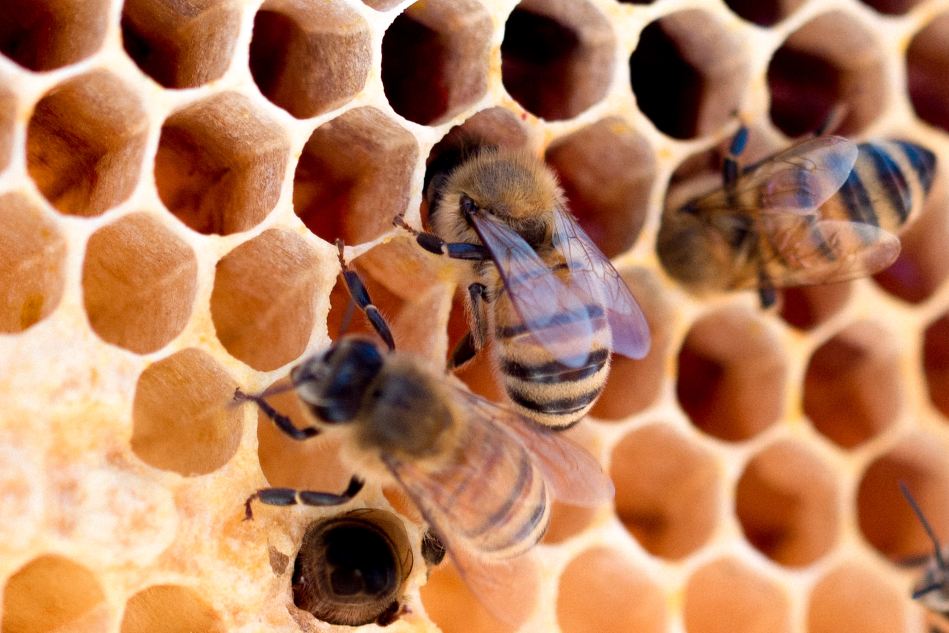
She designs and builds. The hexagon shape she chooses for making comb where she will raise brood and store honey maximizes available space. The hexagon distributes stress across its structure, and is considered the strongest shape.

Bees who build their own comb in trees or in top bar hives construct them in a catenary shape—a   curve supported on either end, a design that has fascinated engineers, architects, and even Thomas Jefferson.  

She navigates. Receptors make the bee sensitive to scent, so she can find flowers and her way home. Researchers found she also senses the electromagnetic field around flowers. Scientists found that bees appear to observe landmarks as they fly, and remember them to find their way back.

She communicates. When a forager bee finds a good source of food, she returns to the hive and performs the waggle dance. The dance tells the others where the food is, and conveys its quality and quantity. If a dancing bee observes another forager telling about a flower patch, and if her grove is better, she dances faster to draw attention away from the other bee.

She cooperates. In the hive, the worker bees divide labor. Some clean the hive, some groom returning foragers and unload pollen, some work in the nursery, some lay down wax, some patch  leaks against drafts, some act as guards, some scout for new locations to live, some feed and groom the queen so egg-laying can proceed with maximum efficiency. 

A lot of research goes into bees these days, because bees are in trouble and they’re so important. Interesting findings have come from this. One study found that bees can count. A recent study showed that bumble bees will play games with balls. During Covid, a study showed bees could efficiently detect Covid, and earlier research had shown that bees detect cancer cells earlier than dogs can.

Other species keep surprising us humans. We believed we were the only species that used tools, until we observed birds, monkeys, rodents and insects doing the same. We thought only humans had language, until we found that whales, dolphins, birds, frogs and others convey complex information to each other. Now we know that trees and sagebrush send messages to their communities.

We remained smug about one thing—we alone were self-conscious. Then one morning, Koko, the gorilla who had been taught sign language, announced, “Koko damn fine gorilla.” (Her last message to humans was, “Help Earth. Hurry!”)

I heard a children’s author say that linguists who studied hundreds of indigenous languages found that before colonization, 70 percent of those tongues didn’t have a word for “human being.” Indigenous people didn’t see themselves as separate from other miraculous beings who shared Creation.

Our incredible minds and intricate bodies deserve to be celebrated. We can feel proud of the ingenuity and goodness humans often show. We can agree with the psalmist who said, “What is mankind that you are mindful of them? . . .You have made them a little lower than the angels.”

But when I peer into a hive, this idea comes to me. I think that I shall never see a creature smarter than a bee. 

bees, pollinators, beekeeping, environment · nature

Importing a Bee Strategy

Sneem, Ireland, a town that restored its bee population, had put ideas in my head.

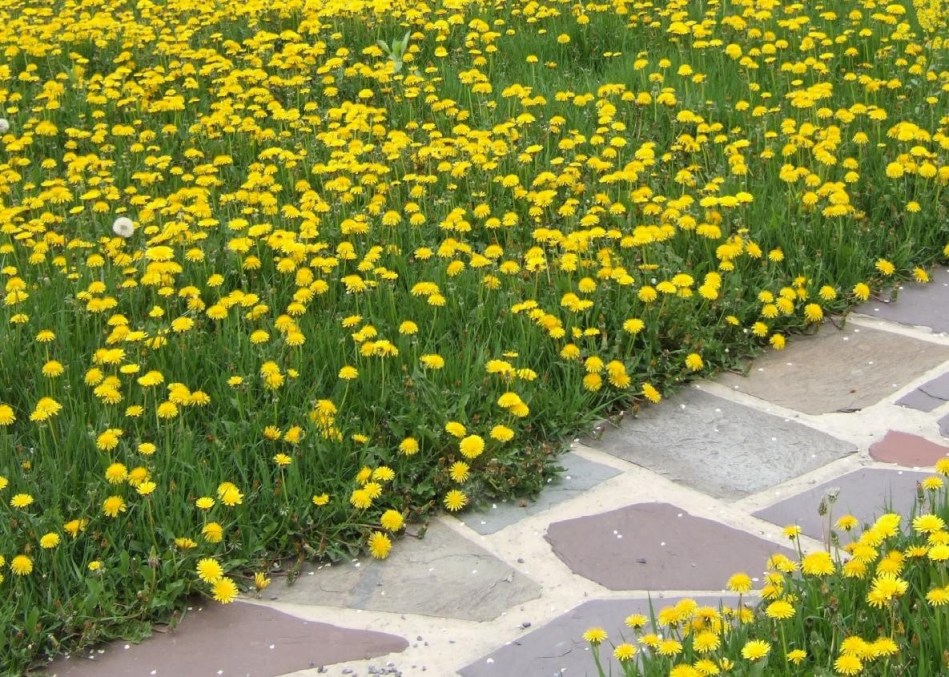
The town had followed a three-prong approach to reviving bees. Residents agreed to 1) not use chemicals on their vegetable or flower gardens, 2) plant a variety of flowers for bee health, and 3) allow dandelions to thrive.

When I got home from Ireland, I talked about Sneem and its bee restoration. Several people expressed remorse about the chemicals they use in their yards. “I know they’re bad,” a friend said, “but we’ve fallen into a habit.” Most folks said they’d be happy to plant flowers that pollinators love. But when it came to the dandelion part of Sneem’s plan, noses wrinkled or, in some cases, people laughed. “How would my neighbors like that?” Antipathy for dandelions ran as deep as dandelion taproots.      

I wrote a letter to the editor of our paper, telling about Sneem’s success. A man sent me an article about the advantages of dandelions, not only to pollinators, but also to lawns. Their long roots help loosen compacted soil, and they put nitrogen into the ground.  

They are entirely edible. People make tea from dandelion roots, and put stems and blooms, which provide Vits A, C and K, and some calcium, into salads. Some people believe eating dandelions helps fight inflammation in the body.

Allowing dandelions in public spaces would be a good place to start, I thought. If dandelions could flourish at the courthouse, in sections of parks, at the library, and along roadways, people could get used to them.

Churches aim to be stewards of the planet—I’d begin there. If one or two churches sanctioned yellow puffs on their lawns, the practice might spread. I wrote a letter to my church’s vestry (governing body) asking them to not mow the dandelions in our church lawn, at least in the springtime. I didn’t hear back. “Of course you didn’t,” a friend said.    

I never heard how the discussion about dandelions went, but good did come of the letter. A month later, a vestry member told me the church had decided to plant a bee garden on a strip of ground beside the church. Next thing, a teen, Xavier Jones, took on the garden as an Eagle Scout project. Xavier studied what flowers bees love, and his troop put in a sprinkler system and planted flowers that would bloom in succession. As soon as flowers were set in the ground, bees showed up, some of them wild varieties.

A senior citizen church member, a flower gardener, dedicated a section of her yard to dandelions.

I live in the country, far from HOAs and rules that restrain me from doing what I want with my yard. For the past years, I haven’t mowed areas where dandelions grow in abundance.  I’ve removed large areas of grass and replaced it with flowers. On the rest of the large lawn, I’ve kept the mower blade high so it wouldn’t lop off dandelion blooms.

This year I will observe No Mow May. The practice started in the UK in 2019 to benefit pollinators. Their bee numbers soared. The next year, Appleton, Wisconsin, adopted the program. Researchers reported a three-fold increase in bee diversity and a five-fold increase in the number of bees in no-mow yards.

The month can occur anytime, adjusting for local weather—when daytime temperatures are in the 60s and nighttime temps range from freezing to the mid-40s. Lawns look somewhat rough following the first mowing after No Mow, but landscapers say the grass comes back healthier.

No Mow May might catch on with the public. In many regions, lawns already face cutbacks. The owner of a local nursery told me water shortages mean landscaping must change in the future.  

Maybe dandelions will yet gain a bigger share of yards. Maybe the dream of Sneem will take hold—far, far from Ireland.