bee health · beekeeping · bees, pollinators, beekeeping, environment · natural cures · nature · Uncategorized

Bee Health around the Globe-Australia

Photo by Amy Blizzard

Bee Health around the Globe. Australia

Australia’s honey producers have something to celebrate and something to mourn.

Australian honey has a reputation for good flavor and purity, and the country is one of the top ten honey producers in the world. Honeybees in Australia live amid an abundance of natural resources in a comparatively pollution-free environment. Bees have a variety of plants to visit, and the climate is mostly favorable.  

The country’s commercial industry mostly operates as nomadic. Hives are moved up to 20 times in a year, either for pollination contracts or for honey production. Beekeepers follow the budding and flowering of plants.

Australia’s native bees are small and stingless. For honey production, beekeepers depend on Asian and European honeybees.   

Australia was the last major country to remain free of the varroa mite, a parasite that has brought calamity to beekeepers around the world. But in 2022, the mite was found in Australian hives.

A government agency jumped into action to keep the mite from spreading. But only two years later, the agency said the mite can’t be eradicated, and shifted its emphasis to trying to contain the parasite. This is the goal in the U.S. also. Beekeepers try to control the spread and lessen the mite’s impact. 

Australia produces a variety of honey on its huge land, with flavors influenced by the local flora. Well-known honeys include:

• Manuka, known for its medicinal properties, produced from the nectar of the Leptospermum (tea trees).  

• Leatherwood, unique to Tasmania, known for its distinctive spicy flavor and aromatic properties.

• Jarrah and Karri, from Western Australia, known for high antimicrobial activity and thick consistency.

• Eucalyptus, with a slightly herbal flavor, harvested from the numerous eucalyptus species across Australia.

The arrival of the destructive varroa mite has been bad news, but the honey industry recently got some good news, too.  Seven years of research on Manuka honey validated its reputation as an antibacterial product. The research confirmed that Australian honey had medicinal properties similar to New Zealand’s well-known manuka honey.

This is a potential boon for the Australian industry. Medical-grade honey sourced from New Zealand earns that country an estimated $75 million a year.

Medical-grade honey has been proven to be an effective treatment for wounds and skin infections. Studies show it can kill superbugs that have built immunity to conventional antibiotics. The honey can be used to treat bacterial infections like C-diff.

“We had assumed that the unique antibacterial activity found in manuka honey is more active and stable than that of other varieties,” a researcher said. “Now, our research confirms this belief and goes a step further. We proved that Australia’s Manuka honey is just as effective, if not better, than New Zealand varieties, based on a survey of 80 Manuka-type Australian honeys.”

Beekeepers believe the research puts Australian Manuka honey on the international radar at a time when antibiotic resistance has been recognized as a global crisis.
bee health · beekeeping · bees, pollinators, beekeeping, environment · natural cures · nature

Bee Health Around the Globe. China

In China, people revere bees as symbols of good luck and prosperity. Bees appear in art and on clothing.

China still leads the world in honey production, and has more than eight million managed colonies. Plus, the country boasts an enviable diversity of managed and wild honeybee species.

But in some rural parts of China, bees have disappeared. Uncontrolled use of pesticides since the 1980s has wiped them out.   

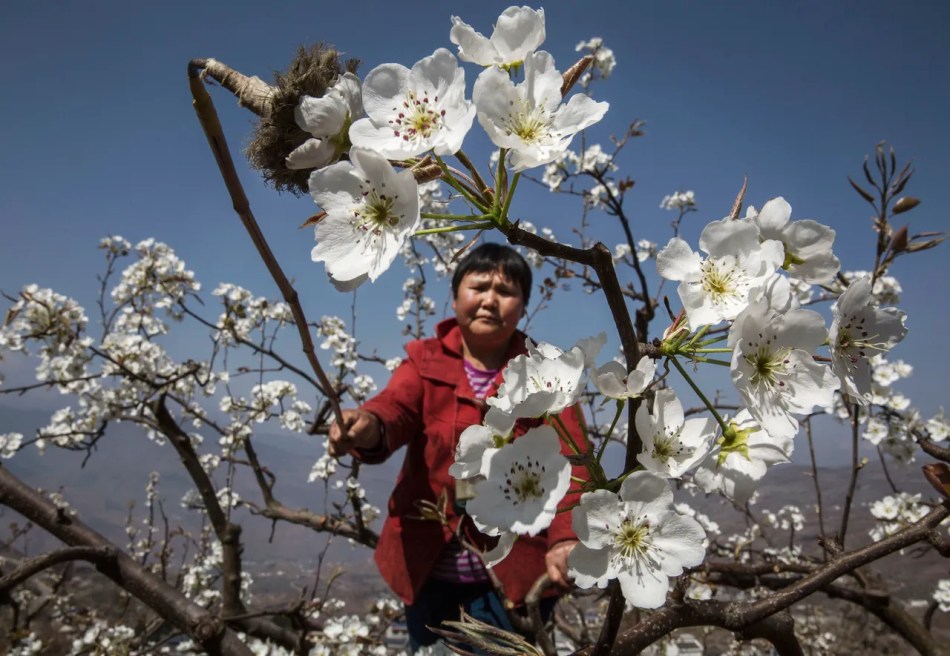
In Southern Szechuan Province, where pear orchards carpet hillsides and produce fruit for the entire country, no bees showed up to pollinate trees in 2013. Farmers reported this to the government. Beijing insisted that the farmers pollinate the crops by hand.

Today, humans do the work bees once did, and it is a laborious undertaking. A worker painstakingly collects pollen and sets it to dry for two days. Then, using a stick of bamboo and chicken feathers to imitate the body of a bee, the worker touches a blossom. A person can pollinate 30 or fewer trees in a day, whereas a hive of bees can pollinate up to three million flowers in that same time.

It isn’t just pear farmers who have learned to hand-pollinate. Apple, cherry, and other fruit growers also use people to pollinate. Farmers have proven adept at doing the work of bees, hard as it is, but some predict this may not be sustainable. As China makes economic strides, young people move to the cities. Some predict that in 10 to 20 years, farmers may not be able to find laborers to hand-pollinate crops.   

Asian bees have coevolved with the varroa mite, the parasite that has proved so destructive to bees in the U.S. and Europe, and have adjusted to it. But other diseases have jumped national borders and threaten Asian colonies. With its unparalleled diversity of managed and wild honeybee species, a further decline of bees in China would be felt globally.

China continues to use pesticides in large amounts. Farmers are told to restrict pesticide use when crops are blossoming, but some beekeepers find they must move their hives to the forests to try to shield them from heavy spraying.

Gloomy predictions say that once bees have been wiped out in an area, repopulation is unlikely.

Better to cherish and save colonies before that occurs.   

Uncategorized

Bee Health Around the Globe-Africa

With bee populations in decline in the U.S., it is natural to wonder how bees are doing around the globe. How about in Africa?

In contrast to the docile European honeybees we raise in the U.S., honey bees in Africa generally live in tree cavities or on the ground, not in manmade hives. Africa has hundreds of millions of colonies.

 African beekeepers have little reason to establish hives near their houses. African bees can be highly aggressive, and special knowledge and precautions are needed to handle them.

When antiapartheid leader Nelson Mandela was still alive, he one day stepped out of the shower at his South African home into a swarm of attacking honeybees. The bees stung repeatedly, and Mandela had to run for cover.

Traditional healers speculated that the ancestors were expressing disapproval. In Xhosa tradition, an encounter with tranquil bees signifies ancestor approval; a visit from angry bees means ancestor displeasure.  

The incident made international news and reinforced the reputation of African bees as nasty critters.    

In the last 20 years, bee researchers from other continents, grappling with the problem of shrinking bee populations, started studying bees in Africa. Honeybee populations in South Africa, Uganda, Kenya and Benin are strong.  

Diseases, either native or imported, exist in colonies, but don’t seem to generate widespread mortality. Some researchers wonder whether our industrial method of beekeeping contributes to the bee crisis. Removing bees from their natural setting and confining them in hives may have weakened them.  

Despite the generally positive situation on the African continent, some decline in populations have been observed. In parts of Madagascar, Kenya. and South Africa, colonies have succumbed to the dreaded varroa mite that plagues U.S. honeybees. And some beekeepers are having more trouble trapping wild swarms to build their stocks.

Killer (African) bees arrived in South America in the 1950s and started migrating north. By the 1990s, they had reached Texas, New Mexico, and Arizona, and have now spread to other Southern states.

A university study in Arizona said that today, 100 percent of Arizona’s wild bee colonies are Africanized, a fact people should know. Bees make their home in holes, walls, trees and junk piles. They are more easily provoked, but look almost identical to our easygoing Italian and Carniolan breeds.

Africanized bees in the U.S. led some warm-climate municipalities to prohibit backyard beekeeping. Beekeepers in those climates, who are trying to maintain non-Africanized colonies, face a steep, uphill battle.   

Some think inbreeding with the hardier African bees may strengthen our domestic genetics. But others warn that trading bees all over the world has negative consequences, not just for people. Bees end up in environments with diseases they have no immunity against. And aggressive breeds displace docile ones.   

We who live in northern states hope Africanized bees won’t come our way due to a warming climate.

Yet, because we depend on honeybees, it is comforting to know that somewhere in the world colonies thrive. If, through selective breeding, the African bee could contribute its hardiness while surrendering its bad temper, that could be a boon. Bees thriving without the intervention of humans is the Holy Grail for scientists and beekeepers.

Scientists hope that Africa shields its healthy colonies from further invading disease.  

bee health · beekeeping · bees, pollinators, beekeeping, environment · natural cures · nature

Checking in on Bee Health

Photo by Amy Blizzard

How are bees doing? What is the latest word on apian well-beeing?

Most of us understand that the bees we depend on to pollinate our crops are floundering. But are things getting better, or worse?   

Pollinator advocates say a recent decision by the Environmental Protection Agency (EPA) spells bad news for bees. The EPA postponed its review of neonics, a family of widely-used, bee-killing pesticides. The agency will not issue a report on neonics until 2026, and the pesticide’s extensive use will continue unrestricted.

Bee lovers fear that colonies cannot wait two years for relief. The precipitous decline in the U.S. bee population continues. Honeybee colonies have died off at an average annual rate of 40 percent over the last decade, and studies conclude that neonics play a major role.   

Bee defenders say the EPA should also consider the health of humans and other species. In the Midwest, neonics are the number one cause of butterfly decline. In humans, research shows that neonics pass from pregnant mothers to the fetus, and into the breast milk of nursing mothers. Studies link neonics to increased risk of birth defects, like malformations in developing hearts and brains.

Even an analysis by the EPA itself concluded that neonics jeopardize the existence of more than 200 threatened and endangered species. Canada, the European Union, and other countries in the world have already put strong restrictions on the pesticides.

In the face of convincing research, why does EPA drag its feet? Critics point to the influence of Big-Ag. Bayer and other agrochemical producers have launched extensive PR and lobbying campaigns. They warn that restricting neonics will harm crop production, but experience has shown otherwise.

In Quebec, Canada, a 2019 crackdown on neonics made farmers reduce their use of neonic-treated corn seed by 99.5 percent. Four years later, crop yield remained consistent. Cornell University found that neonic-treated seed for major crops provided “no overall net income benefit” to farmers.

A single neonic-treated seed can contain enough active ingredients to kill a quarter-million bees. DDT, which the U.S. banned, looks tame compared to neonics. Neonics are 5,000 to 10,000 times more toxic to bees.

The crop absorbs only a fraction of the neonics. The rest leaches into the environment to contaminate soil, rivers and streams, and even drinking water.

Persons who want to complain to the EPA about its decision can sign a National Resource Defense Council (NRDC) petition found online. Other environmental groups may be circulating petitions, too.   

Next time: How are bees doing around the globe?

bees, pollinators, beekeeping, environment · natural cures · nature

Please Won’t You Bee My Neighbor?

The man who taught Beginning Beekeeping advised us to inform our neighbors that we had acquired bees. In his view, it was the neighborly thing to do.  

The first time I raised bees, many years before, we planted our hives on a distant corner of our 40-acre farm. We ignored them. They left, eventually. I planned to do beekeeping with more care this time.

I live on an acre in the country, with lots of room. When I saw my closest neighbors working in their yard, I went over to tell them I had purchased bees and bee houses. I mumbled it, like a confession.   

The couple looked at each other. “Yay!” the man said. The woman said, “Let’s plant our garden close to the fence, so they don’t have to fly far.”

The neighbor I share irrigation water with said, “I hope this helps our pear tree. It hasn’t been doing well.” Today, that neighbor calls the pollinators in her productive pear tree “our bees.” “I’m getting rid of wasp nests,” she says, “to protect our bees.”

A summer celebration in our rural community brings together people from acreages and from farms. The first summer I had bees, I sat down to eat at a table of farmers. A man said to me, “Are you the one with bees?” Uh-oh. Had he been stung? Had my bees annoyed his wife as she hung her wash?  

A suspenseful silence followed. Finally, he said, “We have the best raspberry crop we’ve had in years. Tell your bees thank you.”

A good friend of mine longs to keep bees, but her across-the-street neighbor has a severe allergy. Bees forage a three-mile radius, so the man likely encounters bees, regardless. But I understand not wanting to increase his risk.   

In spring, bees can be a nuisance. They act confused when they first emerge. My neighbors tell me that my bees swarm around their yards. In spring, I can’t go in and out of my house without a bunch of bees following me in.

For years, I tried to capture them individually, with an envelope and a glass. Often, this resulted in accidental deaths. Now I leave the door open. Wasps aren’t out yet, and flies are few. The bees hum around the kitchen for a while, then leave. This investigative phase lasts for only a couple of days.   

One year, I bought used equipment from a beekeeper who lives in town. The city allows for four hives, and that’s what he has—four neat hives snugged up against his house. I asked how his neighbors feel about them.

“They don’t know I have them. Bees go up. In the morning, my bees fly up and away, and the neighbors aren’t aware they live here.”

It looks like beekeepers have a choice. To tell their neighbors, or not. A disadvantage in not telling, seems to me, is that the beekeeper misses out on neighbors’ gratitude.  

Some people don’t want to be near bees. Some people mistake wasps for bees. But even those who are leery of bees understand their importance to everything—vegetables, nuts, alfalfa hay for dairy cows, beautiful flowers.

People miss bees when they aren’t present, and welcome them when they come to a  neighborhood.